
How to Plan Your Business for 2027: 7 Things to Fix Now
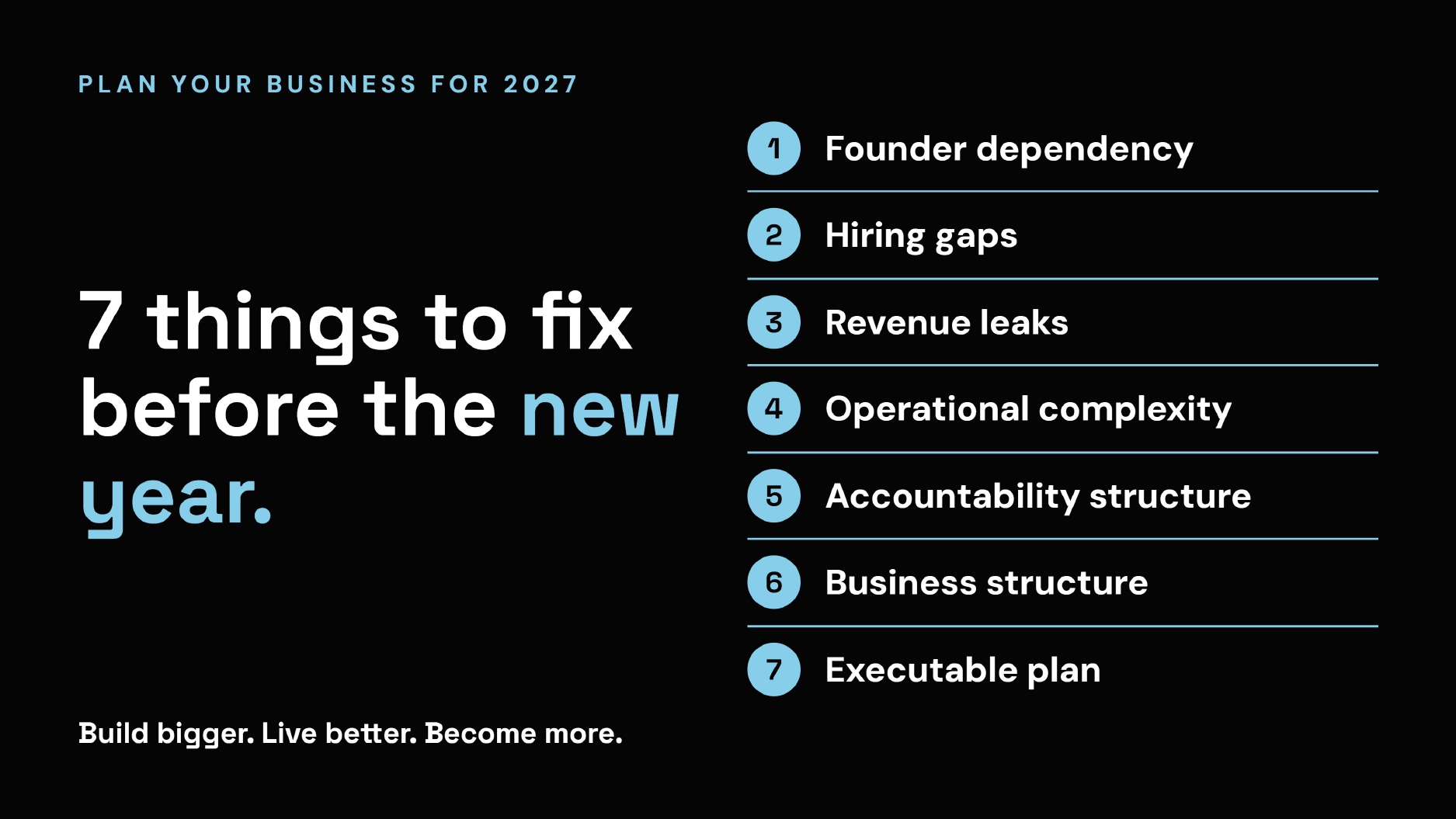
7 Business Growth Gaps to Fix Before 2027
The strongest business plans for 2027 won't begin in January. They'll begin with the decisions business owners make today
As 2026 enters its final months, many founders are already thinking about their next revenue target, new hires, expansion plans and the opportunities they want to pursue in 2027
Setting bigger goals doesn't automatically create a business that can achieve them
If your team is stretched, important decisions still depend on you, leads are slipping through the cracks or daily operations feel harder than they should, adding more growth to the plan may only add more pressure
Before deciding where you want your business to go in 2027, take an honest look at how it operates today
The goal isn't simply to grow bigger. It's to build a business with the people, structure and revenue strategy needed to support that growth
Here are seven areas worth reviewing before the new year
1. Reduce Founder Dependency
In the early stages of a business, founder involvement is often necessary. You make the decisions, manage client relationships, solve problems and keep the business moving
As the company grows, however, that same approach can become a limitation
If every important decision requires your approval, your team cannot move forward without you. If every client escalation lands on your desk, your time becomes the constraint. If progress slows whenever you're unavailable, the business may depend too heavily on one person.
Before 2027, ask yourself:
Which decisions still require my involvement?
What responsibilities could someone else own?
Where does work get delayed while waiting for my approval?
Do my team members understand the boundaries within which they can make decisions?
Start by identifying the recurring decisions and tasks that don't need to remain with you. Assign clear ownership, document the relevant processes and establish expectations for when something genuinely needs to be escalated.
The goal isn't to remove yourself from the business. It's to make your involvement more valuable.
Executive perspective: Decision rights matter as much as delegation. A founder can delegate a task while retaining every approval, which simply moves the bottleneck rather than removing it. Separate decisions by financial exposure, customer impact and reversibility. Routine, low-risk decisions should have clear owners and defined thresholds; material exceptions should follow an escalation path.
Practical next step: Review two weeks of founder approvals. Group them into decisions to delegate immediately, decisions requiring a documented rule, and decisions that genuinely require executive judgment. Track turnaround time and repeat escalations over the next 30 days.
2. Fix Hiring Gaps Before They Become Growth Problems
Hiring becomes expensive when businesses bring people in without clearly defining the problem those hires are expected to solve.
A founder may feel overwhelmed and assume another employee is the answer. If responsibilities overlap, processes are unclear or nobody owns a critical outcome, adding another person may simply introduce more complexity.
Before approving your next hire, consider:
What specific business problem does this role solve?
What outcome should this person be responsible for?
Is the workload consistent enough to justify a dedicated role?
Do we have the budget and management capacity to support this hire?
Can the existing team work more effectively with clearer responsibilities?
The answers will help you distinguish between a genuine capacity gap and an operational problem that needs to be fixed first.
Your hiring plan should support your growth strategy, not operate separately from it.
Review the roles your business will need in 2027, the responsibilities that remain uncovered and the capabilities required to reach your next stage of growth.
Hire for a defined business need, not just because everyone feels busy.
Executive perspective: Diagnose whether the issue is capacity, capability or organizational design before opening a requisition. Capacity calls for more hours or throughput; capability calls for expertise; organizational design calls for clearer ownership and workflow. Evaluate fully loaded cost, utilization, management bandwidth and the expected business outcome. A fractional leader, project specialist or contractor may be a better fit than a permanent hire when demand or expertise needs are uneven.
Practical next step: Write a one-page role business case showing the problem, measurable outcome, expected workload, total cost, alternatives and 90-day success criteria. Do not approve a hire until the business case identifies what improves and how it will be measured.
3. Find the Revenue Leaks in Your Sales Process
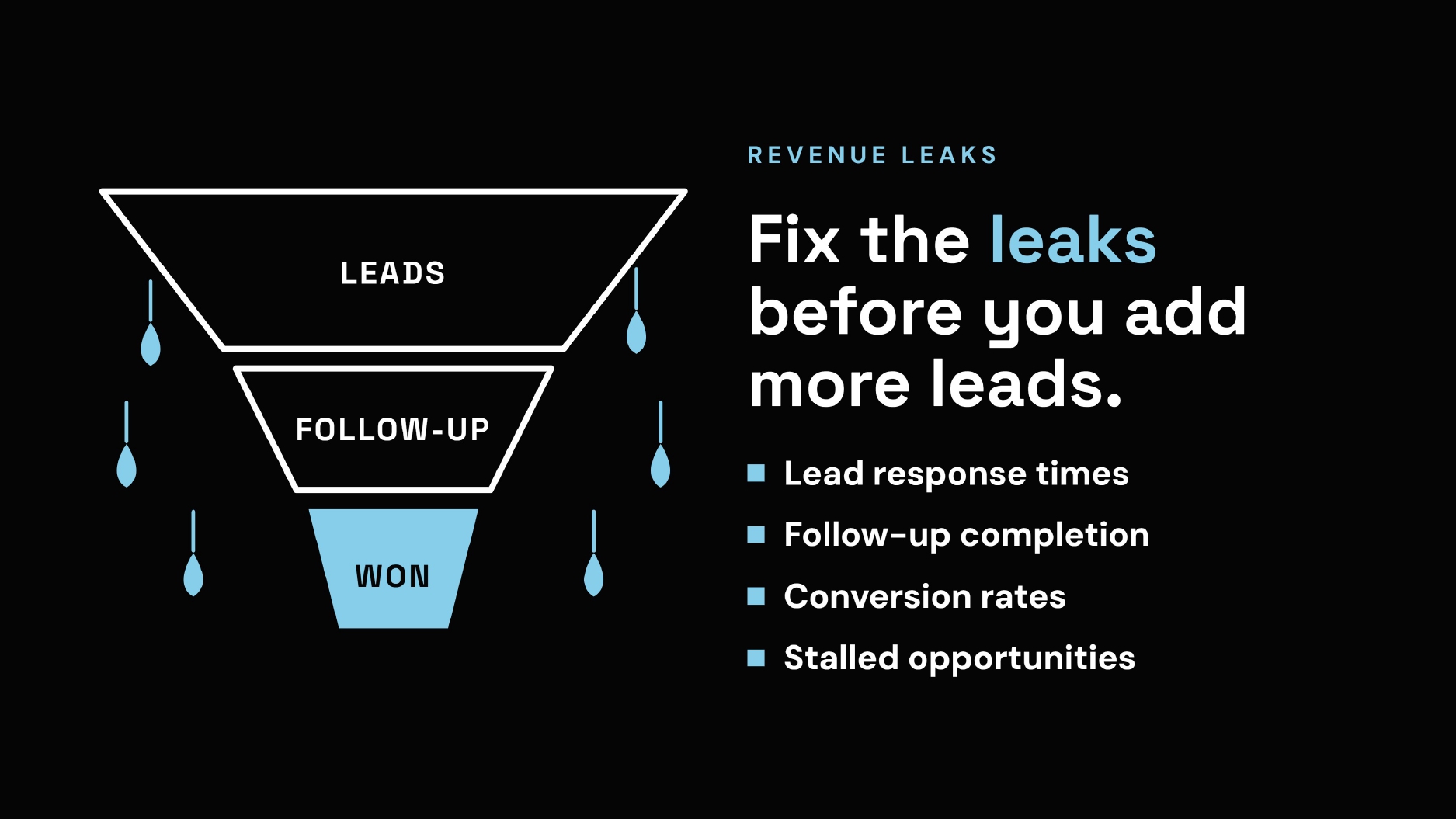
When revenue growth slows, the immediate response is often to generate more leads.
More leads can help. They will not solve a sales process that consistently loses opportunities.
Consider what happens after a prospect expresses interest. Is the lead contacted promptly? Is the next step clear? Does someone own the follow-up? Can you see which opportunities are progressing, stalling or going cold?
Revenue leakage can happen when:
Leads aren't followed up consistently.
Sales opportunities don't have clear owners.
Prospects receive inconsistent communication.
Pipeline stages aren't updated accurately.
The team cannot identify why deals are being lost.
Marketing activity isn't connected to sales outcomes.
Before investing more in lead generation, review the performance of your existing pipeline.
Look at lead response times, follow-up completion, conversion rates, stalled opportunities and the reasons deals are lost. Use a CRM that reflects what is actually happening in the business, rather than treating it as a place to store contact information.
This gives you a more useful starting point for deciding whether you need more leads, a better sales process or both.
Growth isn't only about creating new opportunities. It's also about making better use of the opportunities you already have.
Executive perspective: A CRO examines the full revenue engine, not just lead volume. Segment the pipeline by source and stage, compare stage-to-stage conversion, measure sales-cycle length and distinguish booked revenue from collected revenue. A channel that produces more leads may still underperform if acquisition costs are high or deals have weak margins. The CRM should support management decisions, not merely record activity.
Practical next step: Audit the last 30 to 60 days of opportunities. Measure response time, follow-up adherence, stage conversion, aging and win/loss reasons. Identify the single stage with the largest avoidable loss and assign an owner to improve it before increasing spend.
4. Address Operational Complexity Before Scaling
The processes that worked when you had a small team may no longer be sufficient as the business grows.
Information becomes harder to track. Responsibilities overlap. Decisions take longer. Employees develop different ways of completing the same task. Founders spend more time resolving avoidable problems.
These issues often emerge gradually, which makes them easy to overlook until they begin affecting delivery, customer experience or profitability.
Start by identifying the operational friction that repeatedly slows your business down.
Ask:
Which tasks are repeated unnecessarily?
Where do handoffs between people or departments break down?
Which processes depend on one person's knowledge?
What information is difficult to find?
Which decisions or approvals create recurring delays?
You don't need to document every process at once. Begin with the activities that have the greatest effect on customers, revenue or team productivity.
Clarify who owns each process, document the essential steps and identify where technology or automation could remove unnecessary work.
If you are expanding into new markets or working with international teams, review whether your operating structure, responsibilities and legal arrangements support that expansion.
Scaling should make the business more capable, not simply more complicated.
Executive perspective: Technology does not correct a poorly designed process. First decide whether work should be eliminated, simplified, standardized, delegated or automated. Estimate frequency, labor time, error rate and customer impact before investing in a new tool. AI and workflow automation can help with routing, reporting, intake and follow-up, but sensitive or consequential decisions still need appropriate human review and controls.
Practical next step: Map one high-friction workflow from trigger to completion. Record each handoff, approval and rework loop. Calculate monthly time spent and errors, then redesign the process before testing automation. Compare the cost of implementation and oversight with realistic time savings.
5. Build a Leadership and Accountability Structure That Works
A growing team needs more than talented people. It needs clarity.
When employees don't know what they own, how success is measured or when decisions should be made, even capable teams can struggle to execute consistently.
Founders may interpret missed deadlines or repeated questions as a lack of initiative. Sometimes the underlying issue is that expectations have never been made sufficiently clear.
Before the new year, review how accountability works across your business.
For every important responsibility, establish:
Ownership: Who is accountable for the outcome?
Expectations: What does successful execution look like?
Measurement: How will progress be evaluated?
Communication: When and how should updates happen?
Decision-making: What can the person decide independently?
Keep the structure practical. Too many meetings, reports and approval layers can slow a business down just as easily as too little accountability.
The objective is to give people enough clarity to act confidently while ensuring leadership has visibility into the outcomes that matter.
When responsibilities are clear, founders can spend less time chasing updates and more time making decisions that move the business forward.
Executive perspective: Accountability requires decision authority, a defined outcome and a review cadence. A dashboard without ownership becomes reporting overhead; ownership without authority becomes frustration. Leaders should distinguish leading indicators, such as response time or cycle time, from lagging outcomes, such as retention, revenue or margin, and avoid rewarding activity that does not improve results.
Practical next step: For each major priority, name one accountable owner, two or three measures, decision boundaries and a recurring review date. Use the meeting to resolve exceptions and dependencies rather than to collect updates that should already be visible.
6. Review Your Business Structure Before Expansion
Business growth can create structural requirements that were less urgent at an earlier stage.
Hiring across borders, entering new markets, bringing on partners or preparing for investment can introduce questions about legal entities, contracts, compliance, employment arrangements and governance.
These decisions should not be left until an expansion is already underway.
Review your plans for 2027 and identify the structural questions that need professional attention.
For example:
Are your current business entities appropriate for your planned activities?
Are contracts and responsibilities clearly defined?
Are your employment arrangements suitable for the markets where you operate?
Do you understand the compliance obligations associated with expansion?
Is your business prepared for the due diligence that a potential investor or strategic partner may require?
The right answers will depend on your business, industry and jurisdiction. Seek advice from qualified legal, tax or compliance professionals where necessary.
The important thing is to identify these requirements early enough to make informed decisions.
Your business structure should support where you're going, not become an obstacle once you get there.
Executive perspective: Expansion risk often appears where commercial ambition outpaces legal and operating readiness. The correct employment or contractor model, customer contract terms, data handling, insurance, tax exposure and governance requirements vary by market. Weak documentation can also slow investment diligence or a future sale. Legal and tax specialists should validate jurisdiction-specific requirements; operational leaders must make sure approved controls work in practice.
Practical next step: Build a market-entry risk register for each planned expansion. Record the activity, country or state, responsible entity, workforce model, contractual obligations, required specialist review and decision deadline. Address high-exposure items before commitments are made.
7. Turn Your 2027 Goals Into an Executable Plan
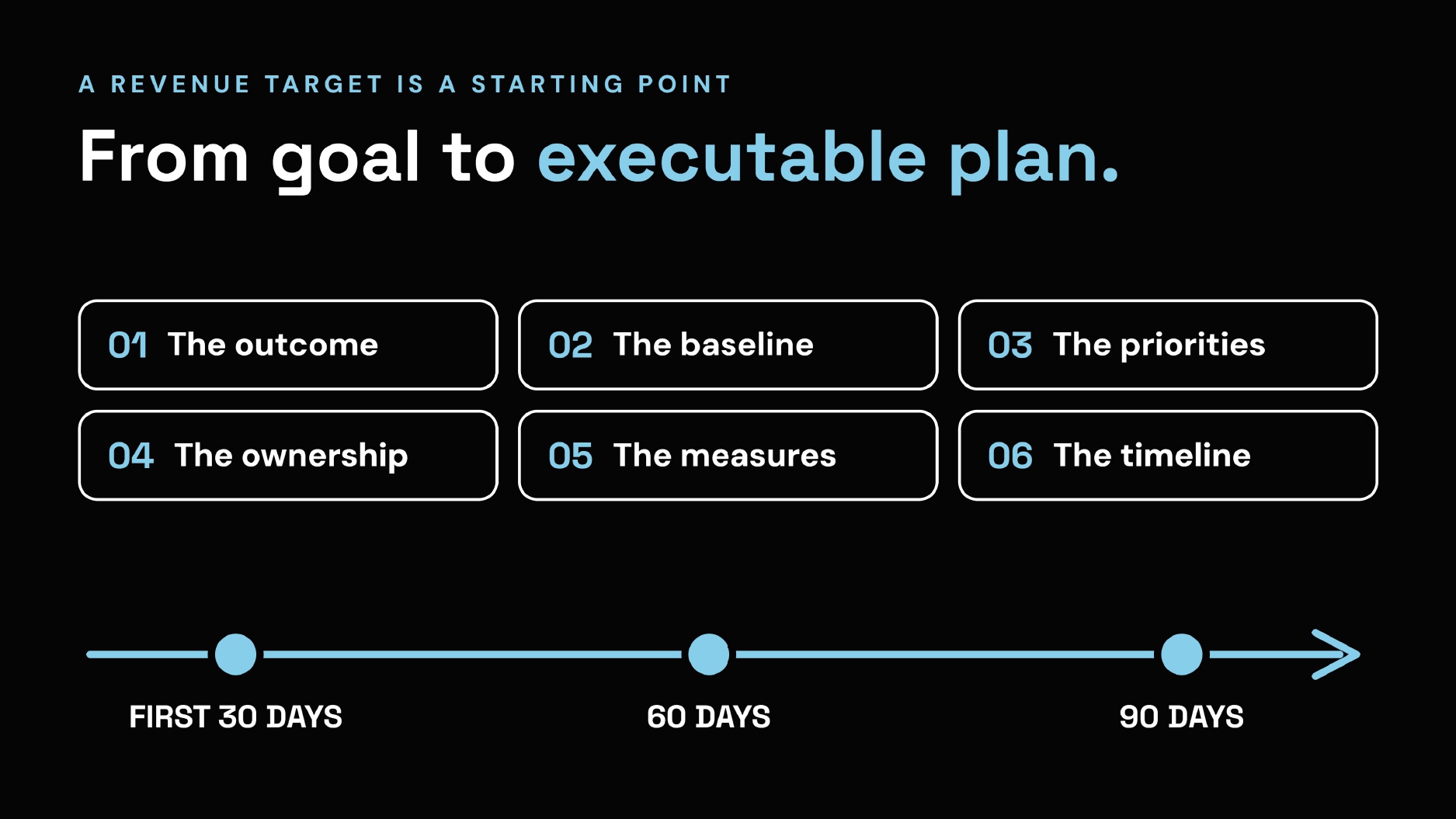
A revenue target is a starting point, not a complete growth strategy.
Saying you want to increase revenue, hire more people or enter a new market doesn't explain how those outcomes will happen.
An executable plan connects the goal to the work required to achieve it.
For each major objective, define:
The outcome: What specifically needs to change?
The baseline: Where does the business stand today?
The priorities: Which actions will have the greatest impact?
The ownership: Who is responsible for moving the objective forward?
The measures: What numbers or milestones will show progress?
The timeline: What needs to happen in the first 30, 60 and 90 days?
Limit your initial priorities to the changes that matter most. Trying to improve every part of the business simultaneously can spread resources too thin and make progress difficult to measure.
For example, if the primary objective is to increase revenue, your first priorities might be improving lead follow-up, clarifying sales ownership and reviewing conversion rates before significantly increasing marketing spend.
If the objective is to reduce founder dependency, your initial priorities may involve delegating decisions, clarifying leadership responsibilities and documenting essential processes.
The plan should reflect the actual constraints and opportunities in your business.
A useful growth plan tells your team what will change, who will own it and how you'll know it's working.
Executive perspective: A credible growth plan is also a resource-allocation plan. Rank initiatives by expected financial impact, urgency, effort, dependencies and the team's capacity to execute. Consider contribution margin and cash timing, not only topline revenue. A 30/60/90-day roadmap should sequence foundational fixes before activities that depend on them.
Practical next step: In days 1–30, establish baselines and owners; in days 31–60, implement the highest-value process or people changes; in days 61–90, measure outcomes, correct what is not working and decide what to scale. Keep a small set of priorities with clear success criteria.
How to Prepare Your Business for 2027: Start With a Diagnosis
You don't need to overhaul your entire business before January.
You do need to understand which problems are most likely to limit your next stage of growth.
Start with three questions:
What's working? Identify the capabilities, processes and people that are already producing results.
What's holding us back? Find the bottlenecks affecting revenue, delivery, leadership or capacity.
What needs to change first? Choose the priorities that will make the biggest difference to your 2027 goals.
Then assign an owner and a deadline to each priority.
This creates a practical bridge between your current business and the one you're planning to build.
It also helps you avoid a common mistake: entering January with ambitious goals but no clear plan for addressing the issues that held the business back during the previous year.
Build Bigger in 2027. Start With What Needs to Change Today
A stronger business doesn't come from setting bigger goals alone.
It comes from understanding what growth requires: the right people, clear responsibilities, reliable processes, visibility into revenue and a structure that supports the next stage
The best time to identify those requirements is before the pressure of a new year turns them into urgent problems
At Global Edge Partners, we believe sustainable growth requires more than one isolated fix. People, structure and revenue need to work together to support the business you're building
If you're planning for 2027 but aren't sure which areas need attention first, start with a clearer picture of where your business stands today
Explore the Business Growth Diagnostic to identify the gaps, priorities and opportunities that deserve attention before the new year. Use those findings to shape a focused 30/60/90-day Growth Blueprint, with clear owners, measurable outcomes and a practical sequence of action
Don't wait until January to build a stronger business.
Identify the gaps holding your business back and discover what to prioritize before 2027.
Take the Business Growth Diagnostic: https://assess.globaledge.partners/
Build bigger. Live better. Become mor